RANTAPUISTO
From riverbank to recreational area
Early history
During the residency period, the riverside area was neglected, despite the plots extending all the way to the river. The gazebo that still stands in the park was built before 1835. It was originally part of the governor’s formal garden and was later owned by the merchant Alexander Toropoff.
The park’s origins
Construction of Rantapuisto began when the spa was established in 1892. Donations made by merchant Abel Malin expedited the project. The shore was filled in, lined with flagstones and landscaped in the mid-1890s.
Floods and renovations
Floods in 1899–1900 destroyed the landscaping, after which the park was replanted almost entirely. Linden trees were planted along the main walkway, and old trees, such as a large poplar, still grow in the area.
Buildings
The Riverside Pavilion, which was built for spa guests, was completed in 1895 and demolished in 1975. A pump well, built in 1895, remains as a reminder of the former market square located at the eastern end of the park.
Today
Rantapuisto is part of Heinola National Urban Park. Together with the spa park and the harbour, it constitutes a nationally significant cultural environment.
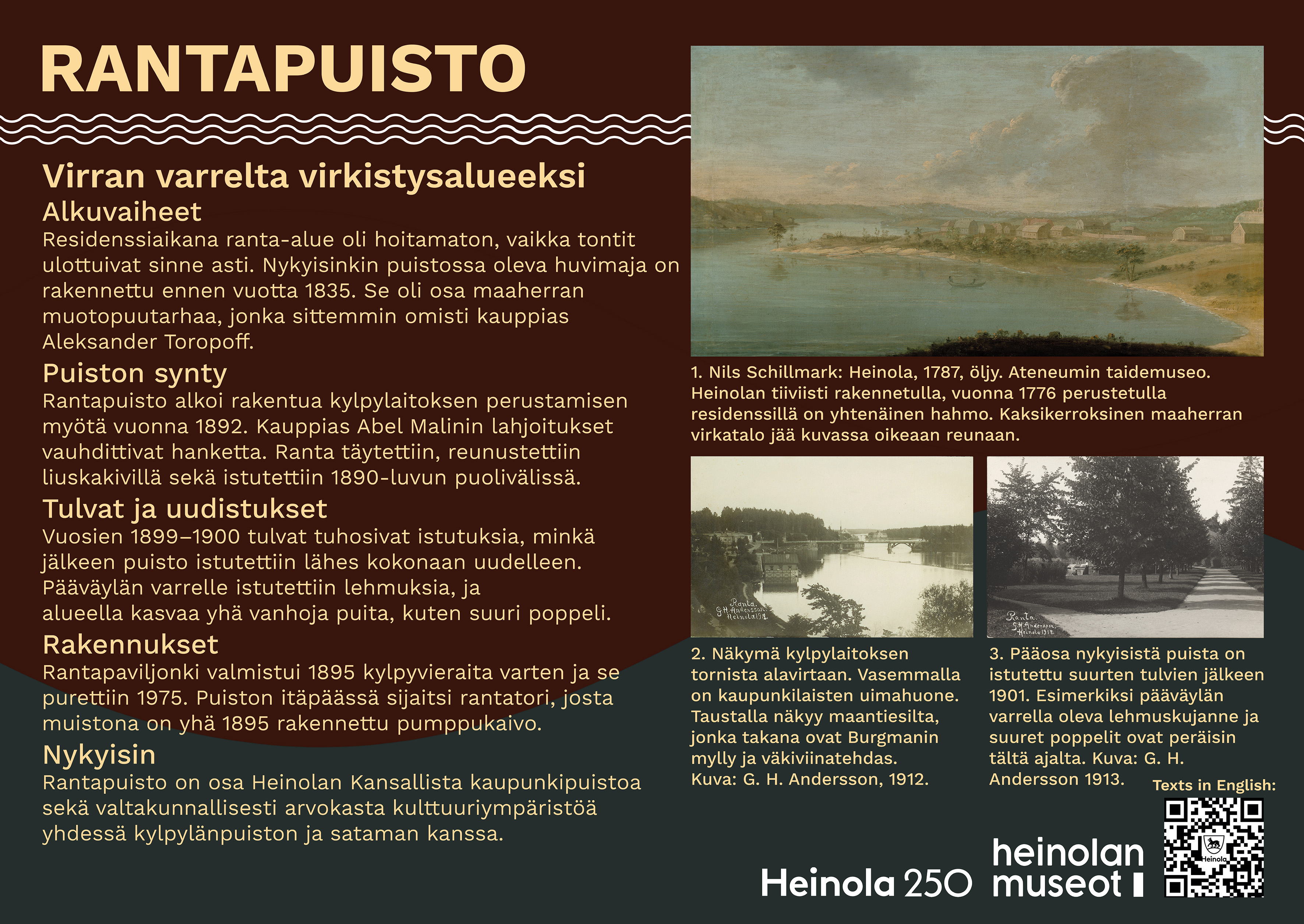
1. Nils Schillmark: Heinola, 1787, oil. Ateneum Art Museum. The densely built Heinola Residence, founded in 1776, has a unified character. The two-storey official residence of the governor is on the far right of the painting.
2. View downstream from the spa tower. On the left is the bathing house for the townspeople. In the background is the road bridge, behind which stand Burgman’s mill and distillery.
Photo: G H Andersson 1912.
3. Most of the trees standing today were planted after the great floods of 1901. The linden alley and the large poplars along the main avenue date from this period.
Photo: G H Andersson 1913.