MAAHERRANPUISTO
Maaherranpuisto (Perspective Park)
Establishment
The governor’s residence was established in Heinola in 1776, and the town was planned by Governor Riddercreutz. In 1786, Robert Wilhelm de Geer added an esplanade-style Perspective Park to the plan.
The plan and subsequent history
The idea behind the Perspective was that a road would branch off from the Great Savonia Road, descending from the direction of the seminary through the park towards the governor’s official residence. Although it was planned to be built at the end of the park on the riverside field, it was never constructed in the end.
Houses for officials were built on both sides of the park. Of these, only the former house of the County Chief Constable Aschan has survived and now serves as a museum. The Perspective is one of Finland’s earliest urban parks. It was modelled on the Place Stanislas in France. The first plantings were made in the 1780s. In the 1835 town plan, part of the park was used as vegetable plots. The park was replanted in the mid-19th century. The seminary’s main building was completed at the upper end of the park in 1901. The park’s original appearance was restored during renovations in 1989–90.
Today
The park is a valuable cultural environment and forms part of the Heinola National Urban Park. It features several monuments, including statues of Uuno Kailas and A F Airo, as well as the Oak Leaf Stone.
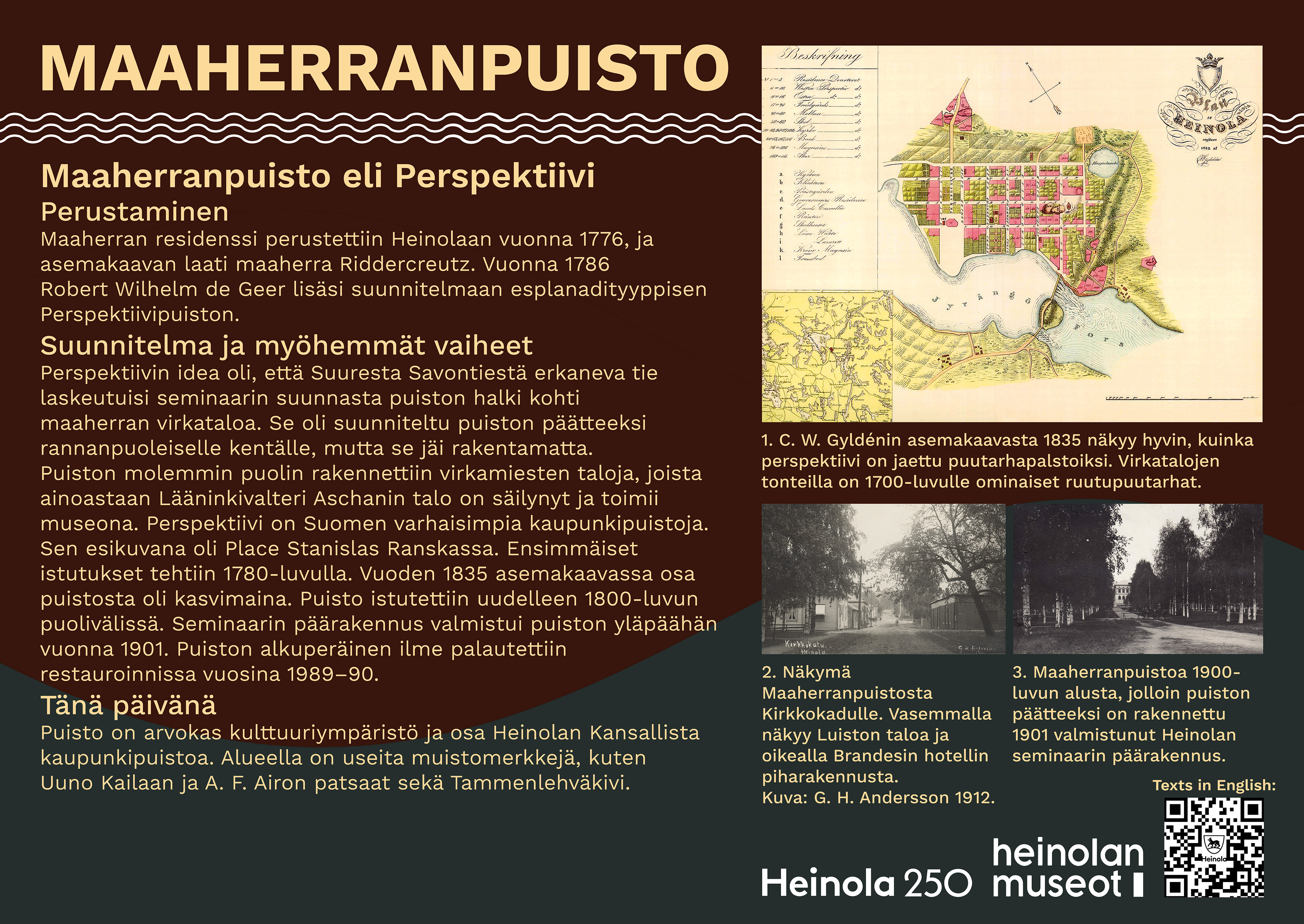
1. C W Gyldén’s 1835 town plan clearly shows how the area was divided into garden plots. The official residences’ plots feature grid-patterned gardens, which are typical of the 18th century.
2. View from Maaherranpuisto towards Kirkkokatu. Luisto House is on the left and the side building of the Brandes Hotel is on the right.
Photo: G H Andersson 1912.
3. Maaherranpuisto in the early 20th century, after the main building of the Heinola Seminary (completed in 1901) had been erected at the end of the park.